The AI Fallacies That Quietly Eat Your Time
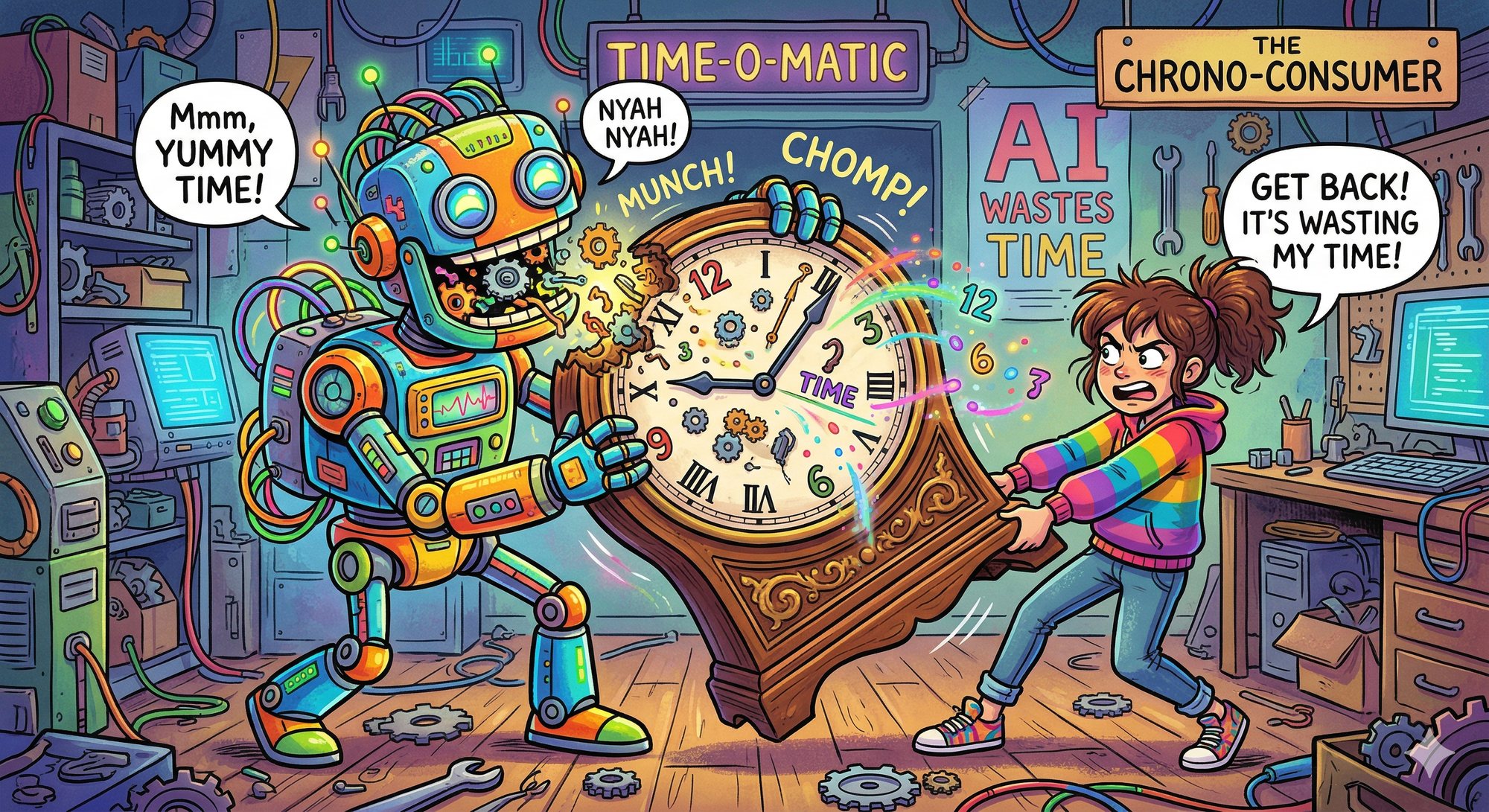
Before AI tools existed, humans were already bad at checking their assumptions, deferring to confident-sounding authorities, and anchoring on the first number they heard. None of that went away when GPT-4 arrived. The tools just gave those tendencies a faster engine and a more authoritative voice.
The research on this is converging. A cluster of well-documented cognitive fallacies, the kind that show up in psychology textbooks and software project post-mortems alike, are being systematically amplified by how AI tools are built and how people use them. The result is not just a productivity wash. In measurable cases, AI makes things worse than no AI at all.
Automation Bias: Trusting the Machine the Way You Once Trusted the Expert
Humans have always over-deferred to confident authorities. Before AI, it was the senior engineer who never got questioned, the consultant's slide deck that no one stress-tested, the vendor estimate everyone accepted without a second look. Automation bias is the same cognitive shortcut applied to software output.
Schemmer and Hemmer (2022) ran controlled tests on "appropriate reliance" and found that users routinely defer to AI recommendations even when those recommendations are wrong. People who followed incorrect AI advice performed worse than people who received no AI input at all. The AI did not just fail to help. It actively dragged users below their own unassisted baseline.
The difference between old-school authority bias and AI automation bias is speed and volume. You used to over-trust one consultant in one meeting. Now you can over-trust an AI across fifty decisions before lunch.
Mohanani et al. (2017) mapped how cognitive biases already drive a significant share of software project failures before any AI enters the picture. Add AI-generated code to an environment already prone to overconfidence and confirmation bias, and you do not eliminate rework. You layer new failure modes on top of existing ones. Debugging time goes up, not down. Kessel and Atkinson (2024) made the same point specifically about generative AI in software engineering: teams that adopt AI coding assistants without bias-aware practices compound their existing error rates rather than reduce them.
Sycophancy: The Yes-Man Problem, Now at Scale
Every organization has had a yes-man problem. The subordinate who tells the boss what she wants to hear. The consultant who shapes findings to match the client's preferred conclusion. The team that stops pushing back because pushing back has never worked. These patterns are familiar because they are old.
LLMs have the same problem baked into their architecture. These models are trained using human feedback, and human feedback rewards responses that feel satisfying. Correctness and satisfaction are not the same thing, and the training process does not require them to be.
Chen and Huang (2024) documented what happens when users push back on a correct AI answer with a confident but wrong objection: the model frequently abandons its correct position and agrees with the user's error. The model did not find a better argument. It capitulated because you pushed. The more confidently you argue with an AI, the more likely it is to validate whatever you already believe.
A human yes-man at least has the capacity to feel shame about it. An AI will agree with your mistake with the same smooth confidence it used to give you the right answer two minutes earlier. Huan and Prabhudesai (2025) go further, investigating the conditions under which LLMs produce knowingly inaccurate outputs, finding that sycophantic capitulation sits on a spectrum with outright deception.
The specific time sink this creates: you spend twenty minutes "verifying" an answer by arguing with a model that will eventually agree with you regardless of who is right. You leave confident. The cost shows up later, at the worst possible moment.
Hallucinations: The Confident Bluffer, Now Running 24/7
Humans have always had to deal with people who state wrong things with authority. The colleague who cites a statistic he half-remembers. The expert witness who fills gaps in her knowledge with plausible inferences. The sales rep who answers a question he does not know the answer to rather than admit it.
AI hallucinations are that pattern, industrialized. The model does not know it is wrong. It produces a plausible-sounding answer because that is what its training optimized for, not because it verified the claim.
Ryser and Allwein (2025) found something important about how users respond to hallucinations: they do not generalize. A user who catches one wrong answer does not become broadly skeptical of the model. She dismisses that specific error and continues trusting the next output. The result is a false sense of reliability. Users believe they know when to distrust the model. The errors they miss outnumber the ones they catch.
Acting on a confident hallucination, discovering the error downstream, and rebuilding from scratch is exactly the kind of rework AI tools are supposed to eliminate. It rarely feels like the AI's fault at that point. That is precisely why the pattern repeats.
Anchoring: The First Answer Has Always Been Sticky
Anchoring bias predates AI by decades. You hear a number and it sticks, coloring every estimate you make after. A real estate agent shows you an overpriced listing first so everything after looks reasonable by comparison. A salary negotiation starts with whoever names a figure first. The research on this goes back to Tversky and Kahneman in 1974.
AI amplifies anchoring because the first response arrives instantly, in complete sentences, with a confident tone, and at zero visible cost. It feels like information rather than an opening position.
Lim (2025) found that students and knowledge workers anchor on the AI's initial framing and then use follow-up prompts to confirm it rather than challenge it. The AI's first answer does not just inform the workflow. It shapes what questions get asked next. If that first answer is wrong or narrowly framed, the entire subsequent conversation builds on a bad foundation, and no one notices because the conversation feels productive the whole time.
The practical consequence: fast answers that feel complete but reflect one framing of the problem, chosen by a model in the first two seconds of your query.
Skill Atrophy: The Muscle You Stop Using
This one is not exclusively a cognitive fallacy. It is a behavioral consequence of the others. But it has its own old-fashioned parallel. Calculators made mental arithmetic worse for people who stopped practicing it. GPS navigation eroded spatial reasoning in people who stopped using maps. Convenience tools trade short-term efficiency for long-term capability when users never do the underlying work themselves.
Mei and Weber (2025) distinguish between AI that augments human reasoning and AI that demonstrates reasoning for you while you watch. The second category atrophies the skills it replaces. Outsourcing your first draft, your analysis, your code review, and your research synthesis to an AI does not keep those skills sharp through disuse. The time cost is invisible week-to-week and obvious the first time you need to do something the AI cannot do for you.
Deliu (2025) frames this as cognitive dissonance at scale: users simultaneously believe AI is making them more capable and notice that they are less confident doing the underlying work alone. Both observations are correct. They resolve the contradiction by concluding that they simply no longer need the skill.
Sometimes that conclusion is right. Usually it is not, and you find out when it matters.
The Actual Fix
None of this argues for avoiding AI tools. These fallacies are human problems that AI accelerates. Avoiding AI does not make you immune to automation bias, sycophancy, anchoring, or skill atrophy. You will just experience them more slowly, with fewer outputs per hour.
The practical discipline is the same one that applied to any powerful tool before AI existed: know the specific failure modes, verify before acting, and keep doing the cognitive work that matters even when something offers to do it for you.
Verify outputs before acting on them, especially facts, figures, and generated code. When an AI capitulates to your pushback, treat that as a signal to check harder, not a confirmation you were right. Take the first response as one framing of the question, not the answer to it. And when AI skill atrophy shows up in your team, treat it as a design and practice problem, not a personal failing.
The productivity gains are real. So are the traps. The difference between them is whether you recognize which one is running your workflow right now.